T6 B, 1963
The tie-string kit, and the year the most changed at once
More changed in the 356 tool kit in 1963 than in any other year of production. The bag stopped closing with a leather belt and closed with a tie string instead.Settled Citation 1Tool bag closure runs belt (1950-62), tie-string (1963), two metal clasps (C 1964-66).Who says so Eric CherneffApplies to allRead the sourcesJim Perrin, “The 356 T6B “Tie-String” Tool Kit”, Vol. 25 No. 6A.C. Roda, “356B Tool Kit Configurations”, Vol. 18 No. 2Correct or add to this → · How these pages work The Hazet 772/2 lug wrench, in the kit since the first cars, was dropped.Settled Citation 127The 1963 tie-string kit dropped the Hazet 772/2 for a cheaper lug wrench, which doubled as the jack handle and forced the addition of a separate hubcap puller.Who says so Eric CherneffApplies to 1963Read the sourcesJim Perrin, “The 356 T6B “Tie-String” Tool Kit”, Vol. 25 No. 6A.C. Roda, “356B Tool Kit Configurations”, Vol. 18 No. 2Correct or add to this → · How these pages work So was the tire gauge, and so was the stubby screwdriverSettled Citation 40The 1963 T6 B kit drops the stubby screwdriver and the tire gauge and adds the hubcap puller.Who says so Eric CherneffApplies to 1963Read the sourcesJim Perrin, “The 356 T6B “Tie-String” Tool Kit”, Vol. 25 No. 6Correct or add to this → · How these pages work.Settled Citation 158The 1963 kit contains no gauge at all.Who says so Eric CherneffApplies to 1963Read the sourcesJim Perrin, “The 356 T6B “Tie-String” Tool Kit”, Vol. 25 No. 6Correct or add to this → · How these pages work
What went in was cheaper, and one change forced another. The Hazet lug wrench had carried a hubcap puller hidden beneath its handle. When it went, the puller had to be added back as a separate tool,Settled Citation 19A separate hubcap puller appears in 1963.Who says so Eric CherneffApplies to 1963Read the sourcesJim Perrin, “The 356 T6B “Tie-String” Tool Kit”, Vol. 25 No. 6A.C. Roda, “356B Tool Kit Configurations”, Vol. 18 No. 2Correct or add to this → · How these pages work which is why 1963 is the first year with a loose hubcap puller in the roll.
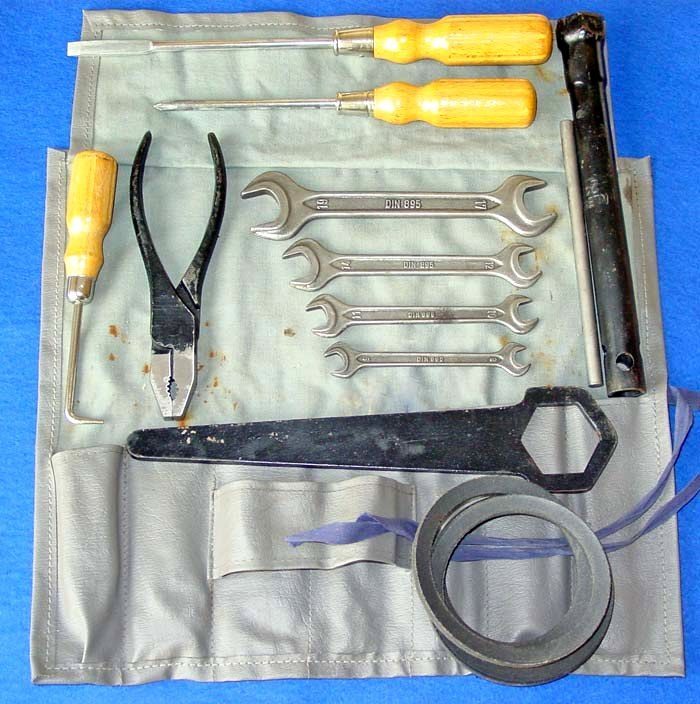 The 1963 kit laid out. Tie-string bag, DIN 895 wrenches, Klein 21 spark plug socket, and the separate hubcap puller. Eric Cherneff
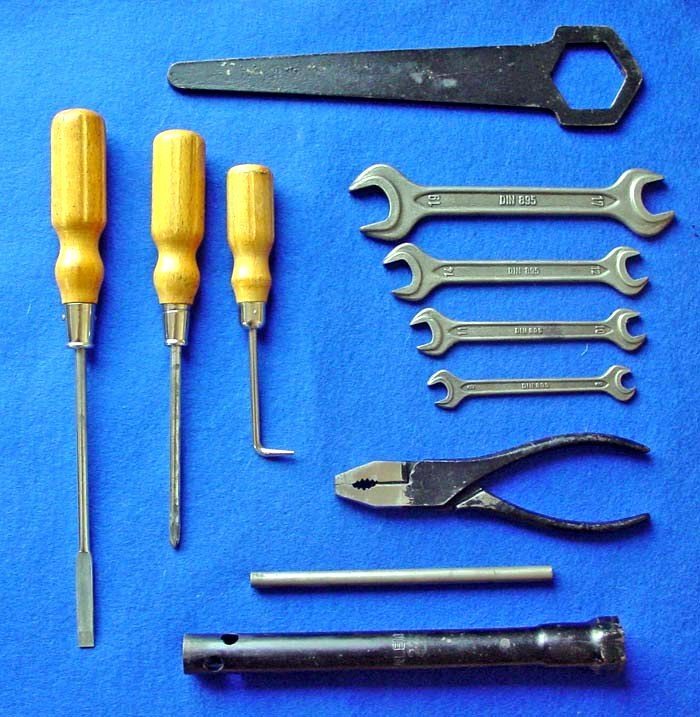 The same contents clear of the bag. Blonde handles throughout, and no tire gauge. Eric Cherneff
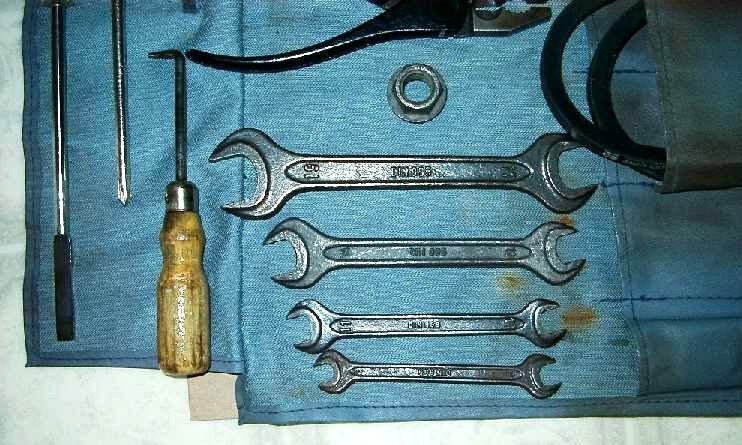 A 1963 kit as found, part unrolled. Eric Cherneff
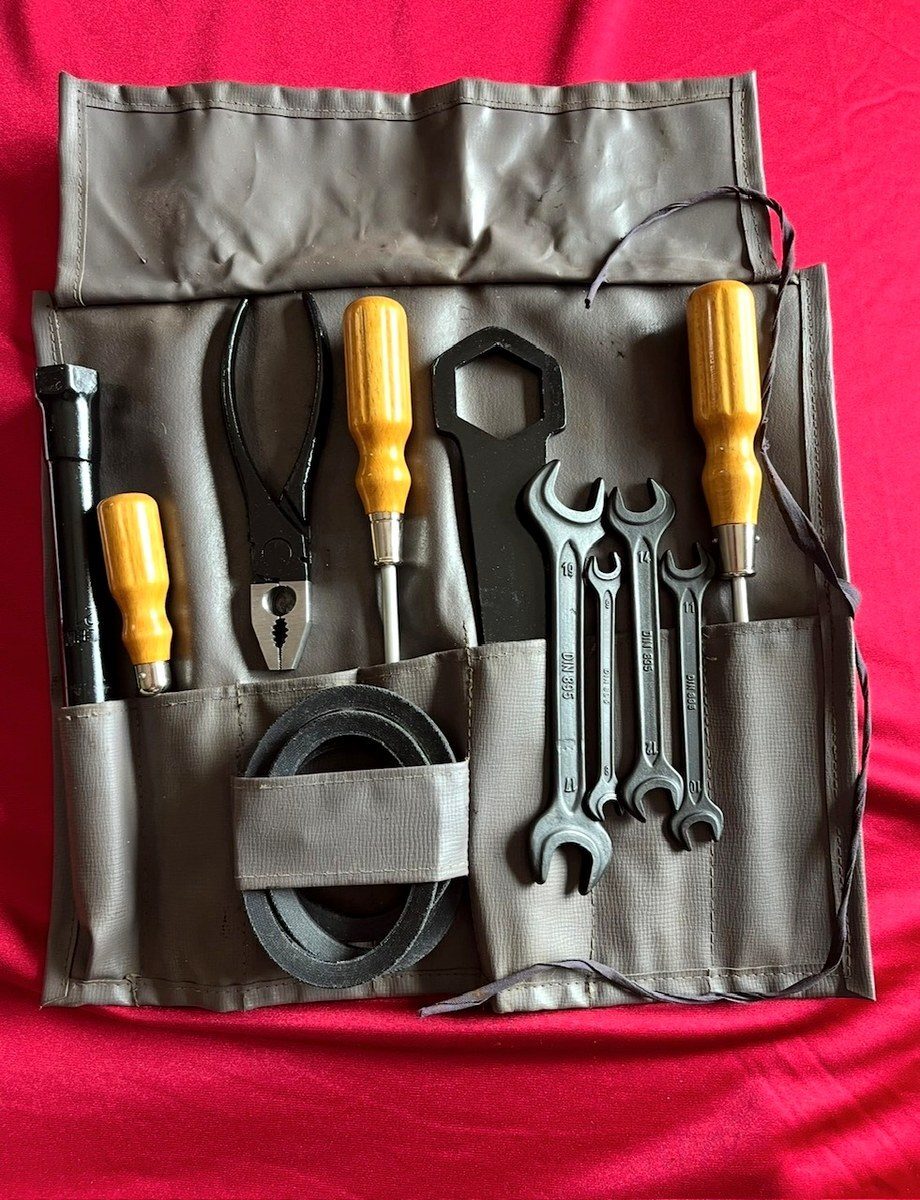 A complete 1963 kit in known ownership, laid out. The tie strings hang from the top edge. Joe Owen
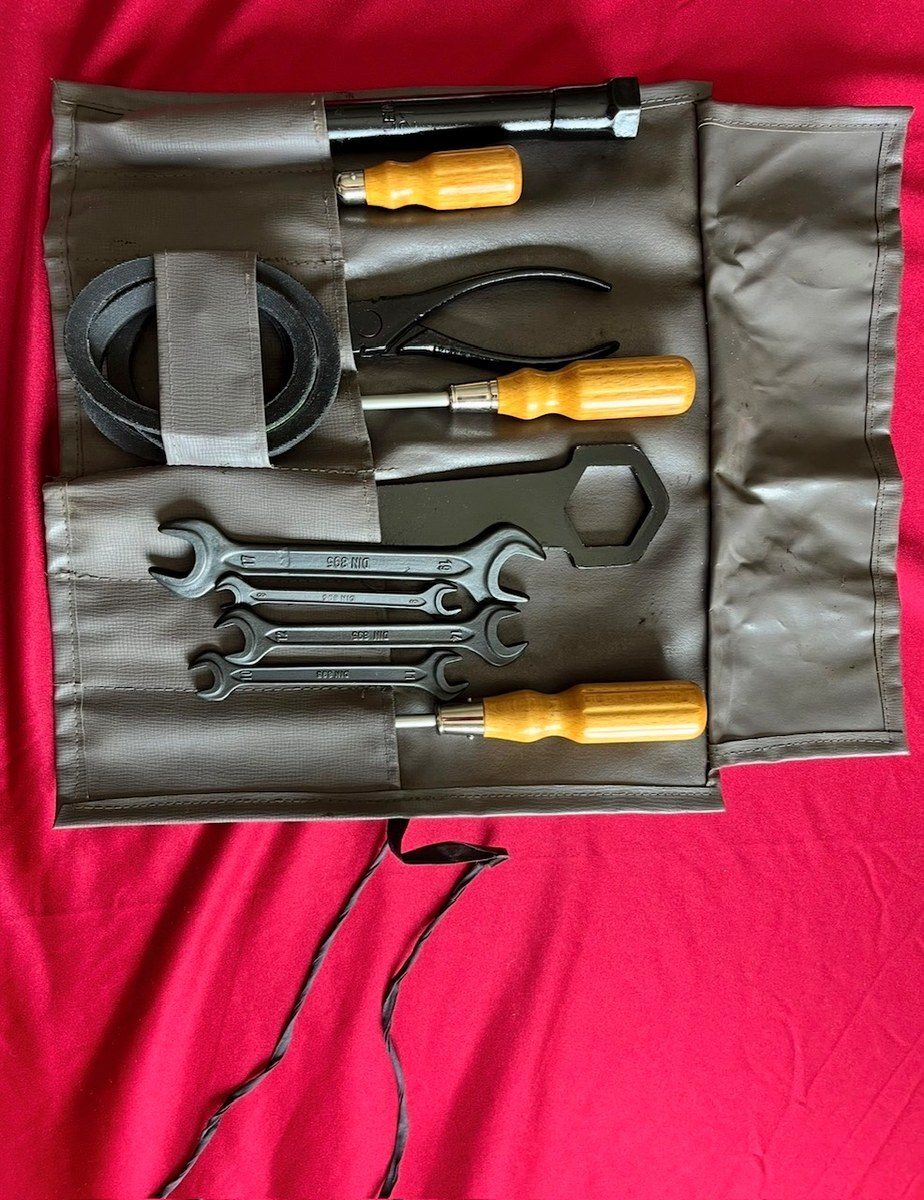 The same kit part rolled, showing how the tie string works. Joe Owen
What is in the kit
- Tool bag, closed with a tie string
- Long slot screwdriver, blonde handle
- Phillips screwdriver, blonde handle
- Combination pliers
- Open-end wrenches, 8x9, 10x11, 12x14 and 17x19mm
- Generator pulley wrench, painted
- Spark plug wrench with tommy bar, Klein 21
- Combined lug wrench and jack handle
- Hubcap puller
- Jack
- Spare lug nut and fan belt
Not in this kit, though it was in the one before and the one after: the tire gauge.Settled Citation 6Tire gauge is absent from the 1963 tie-string kit and returns for C.Who says so Eric CherneffApplies to 1963Read the sourcesJim Perrin, “The 356 T6B “Tie-String” Tool Kit”, Vol. 25 No. 6Correct or add to this → · How these pages work Also gone, and not coming back: the stubby screwdriver.
Tool by tool
The bag
The 1963 bag closes with laces rather than a belt, which is where the collector name comes from. At least three versions are known: blue with a white lining, gray two-sided vinyl, and gray vinyl with a gray lining.Typical Citation 56The late T6 B bag uses laces rather than a belt. Cherneff records three versions and marks two of the lace colors with a question mark: blue with white lining, gray two-sided vinyl, and gray vinyl with gray lining.Who says so Eric CherneffApplies to late 1962-63Read the sourcesA.C. Roda, “356B Tool Kit Configurations”, Vol. 18 No. 2Jim Perrin, “The 356 T6B “Tie-String” Tool Kit”, Vol. 25 No. 6Correct or add to this → · How these pages work The early T6 bag it replaced kept the T5 shape in a lighter gray vinyl with a softer grain and wider stitching, and still used a belt.Typical Citation 55Early T6 B bag keeps the T5 shape with lighter-weight gray vinyl, a softer grain, wider stitching at about 5.5 stitches per inch, and a soft brown leather belt.Who says so Eric CherneffApplies to 1962Read the sourcesA.C. Roda, “356B Tool Kit Configurations”, Vol. 18 No. 2Correct or add to this → · How these pages work
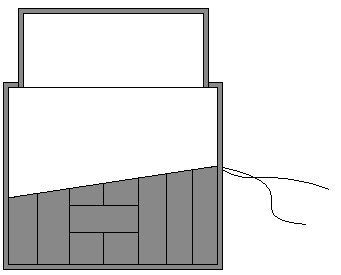 A 1963 tie-string bag, opened out. Eric Cherneff
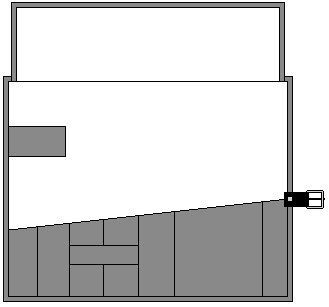 The early T6 layout for comparison, still closing with a belt. Eric Cherneff
Wrenches
Four wrenches, and both the maker and the sizes change. The 1963 wrench is a generic type marked DIN 895, in black oxide rather than the satin chrome of the Hazet 450s before it, with the sizes cast rather than stamped.Typical Citation 73The 1963 wrench is a generic DIN 895 in black oxide, sizes cast, possibly GEDORE or HEYCO.Who says so Eric CherneffApplies to 1963Read the sourcesJim Perrin, “The 356 T6B “Tie-String” Tool Kit”, Vol. 25 No. 6Correct or add to this → · How these pages work The pairing changes too: 8x9, 10x11, 12x14 and 17x19mm, where the earlier kits ran 8x9, 10x14, 11x12 and 17x19.Settled Citation 10DIN 895 wrenches in 8/9, 10/11, 12/14, 17/19 appear for 1963.Who says so Eric CherneffApplies to 1963Read the sourcesJim Perrin, “The 356 T6B “Tie-String” Tool Kit”, Vol. 25 No. 6Correct or add to this → · How these pages work
DIN 895 is not a kind of wrench. It is a German industrial standard for an open-end wrench with two ends of differing sizes, specifying size, tolerance, finish and hardnessSettled Citation 75DIN 895 was a German Industrial Standard specifying size, tolerance, finish and hardness; a wrench marked DIN 895 complied with all of it.Who says so Eric CherneffApplies to n/aCorrect or add to this → · How these pages work.Settled Citation 271DIN 895 specifies an open-end wrench with two ends of differing sizes. Every wrench supplied in a 356 tool kit was a DIN 895 wrench.Who says so Jim Wayman, Registry trustee, by emailApplies to allCorrect or add to this → · How these pages work Every wrench in every 356 kit met it, including the Hazet 450s of the previous thirteen years. What changes in 1963 is who made them, not what standard they were built to.
Black oxide wrenches in 8-13 and 10-13mm were supplied only in VW kits. They turn up regularly offered as VW-Porsche tools and they were never in a 356 roll.Settled Citation 308Black oxide 8-13mm and 10-13mm open-end wrenches were supplied only in VW kits, and are frequently offered on eBay as a VW-Porsche tool.Who says so Jim Perrin, writing in the Registry magazineApplies to 1963Read the sourcesJim Perrin, “The 356 T6B “Tie-String” Tool Kit”, Vol. 25 No. 6Correct or add to this → · How these pages work
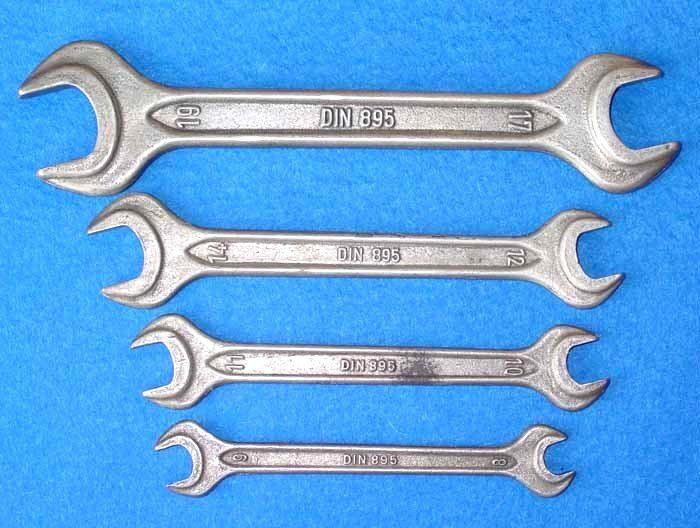 The 1963 set, black oxide with cast sizes: 8x9, 10x11, 12x14 and 17x19mm. Eric Cherneff
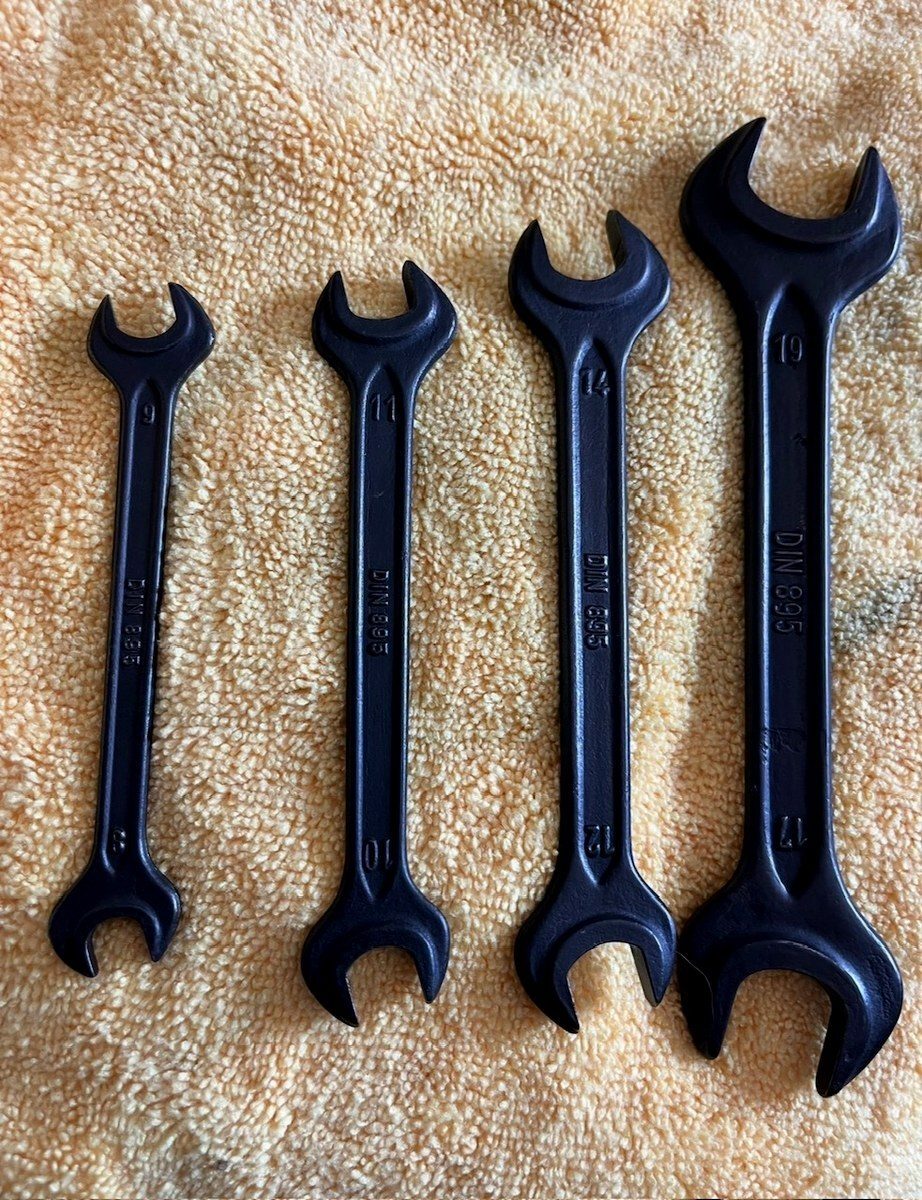 The four 1963 wrenches, black oxide, with DIN 895 legible on each. DIN 895 is the specification, not the maker. Joe Owen
Screwdrivers
Two, both with blonde clear-varnished handles rather than the red-brown painted wood of the earlier kits. The long slot driver is 270mm, unmarked, and its tip is flattened and lengthened so it can hold the generator pulley while you work the fan belt.Settled Citation 101The 1963 long screwdriver is unmarked with a blonde clear-varnished handle, 270mm, duckbill tip.Who says so Eric CherneffApplies to 1963Read the sourcesJim Perrin, “The 356 T6B “Tie-String” Tool Kit”, Vol. 25 No. 6Correct or add to this → · How these pages work The Phillips is 210mm, also unmarked, also blonde.Typical Citation 102The 1963 Phillips is unmarked with a blonde clear-varnished handle, 210mm.Who says so Eric CherneffApplies to 1963Correct or add to this → · How these pages work
The stubby screwdriver that had been in every kit since 1950 is gone.Settled Citation 40The 1963 T6 B kit drops the stubby screwdriver and the tire gauge and adds the hubcap puller.Who says so Eric CherneffApplies to 1963Read the sourcesJim Perrin, “The 356 T6B “Tie-String” Tool Kit”, Vol. 25 No. 6Correct or add to this → · How these pages work
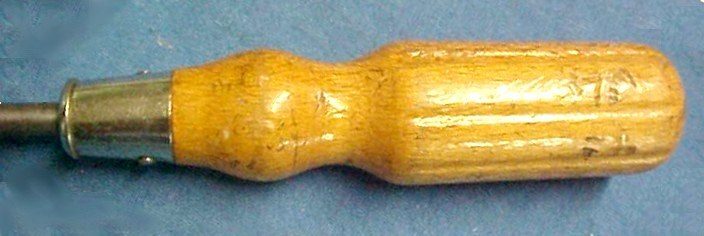 The 1963 long slot screwdriver: 270mm, blonde clear-varnished handle, no markings. The tip is flattened and lengthened so it can hold the generator pulley. Eric Cherneff
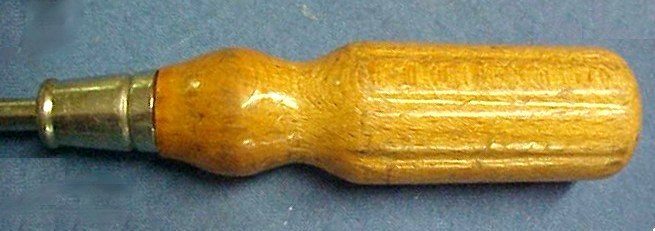 The Phillips, 210mm, also blonde and also unmarked. Eric Cherneff
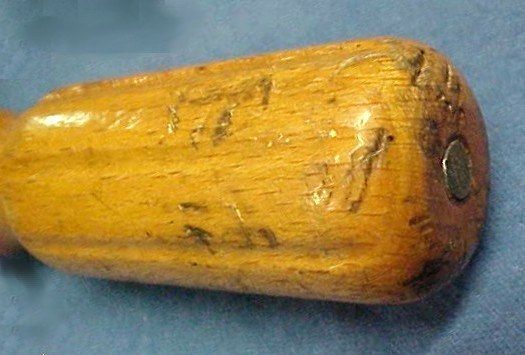 The blonde handle close in. Clear varnish over bare wood, where every kit before this one had painted handles. Eric Cherneff
Spark plug socket
The Hazet 763 gives way to a socket marked KLEIN 21,Settled Citation 14Klein 21 painted spark plug wrench replaces the Hazet 763 for 1963.Who says so Eric CherneffApplies to 1963Correct or add to this → · How these pages work painted black, about 215mm long. Its tommy bar is 150mm and black oxide.Settled Citation 118The 1963 socket is marked KLEIN 21, painted black, about 215mm, with a 150mm black-oxide tommy bar.Who says so Eric CherneffApplies to 1963Correct or add to this → · How these pages work
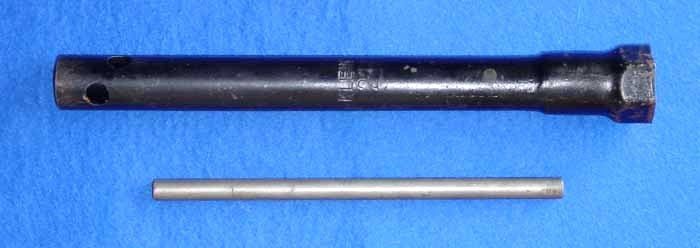 KLEIN 21, painted black, about 215mm long. Eric Cherneff
Lug wrench and jack handle
One tool doing two jobs.Settled Citation 17Combined lug wrench and jack handle, painted, arrives 1963.Who says so Eric CherneffApplies to 1963Read the sourcesJim Perrin, “The 356 T6B “Tie-String” Tool Kit”, Vol. 25 No. 6Correct or add to this → · How these pages work An elongated L in black oxide, stamped 19mm near the socket end, it turns the lug nuts and cranks the jack.Settled Citation 135The 1963 combined lug wrench and jack handle is an elongated L, black oxide, stamped 19mm at the socket end.Who says so Eric CherneffApplies to 1963Read the sourcesJim Perrin, “The 356 T6B “Tie-String” Tool Kit”, Vol. 25 No. 6A.C. Roda, “356B Tool Kit Configurations”, Vol. 18 No. 2Correct or add to this → · How these pages work It replaced the Hazet 772/2, which had done neither job as a jack handle and had carried a hubcap puller besides. The C cars kept the same tool in brushed chrome.Settled Citation 136The C version matches the 1963 tool in brushed chrome.Who says so Eric CherneffApplies to 1964-65Correct or add to this → · How these pages work
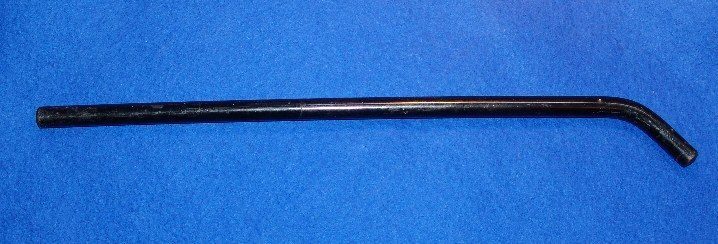 The combined 1963 lug wrench and jack handle, stamped 19mm near the socket. Eric Cherneff
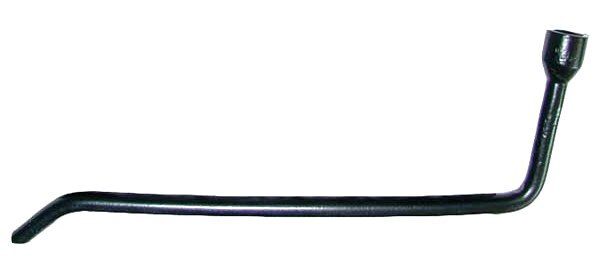 What replaced it for 1964-65, for comparison. Eric Cherneff
Hubcap puller
New for 1963, and only because the lug wrench stopped providing one.Settled Citation 19A separate hubcap puller appears in 1963.Who says so Eric CherneffApplies to 1963Read the sourcesJim Perrin, “The 356 T6B “Tie-String” Tool Kit”, Vol. 25 No. 6A.C. Roda, “356B Tool Kit Configurations”, Vol. 18 No. 2Correct or add to this → · How these pages work About 145mm overall, it looks like a small screwdriver with a blonde handle, bent through ninety degrees roughly a centimeter from the end and finished with a point.Settled Citation 195The hubcap puller is about 145mm overall, looks like a small screwdriver with a blonde handle, and has a 90 degree bend about 1cm from the end finished with a point.Who says so Eric CherneffApplies to 1962-63Read the sourcesA.C. Roda, “356B Tool Kit Configurations”, Vol. 18 No. 2Jim Perrin, “The 356 T6B “Tie-String” Tool Kit”, Vol. 25 No. 6Correct or add to this → · How these pages work The point goes into the small holes around the rim of the hubcap.Settled Citation 196The hubcap puller works through the small holes around the hubcap perimeter.Who says so Eric CherneffApplies to 1962-63Correct or add to this → · How these pages work
Buying one. Reproductions sold for years by Stoddard are distinguished by two flat surfaces on opposite sides of the handle. Originals are fluted like the screwdrivers.Settled Citation 197Stoddard reproduction hubcap pullers are distinguished by two flat surfaces on opposite sides of the handle rather than flutes.Who says so Eric CherneffApplies to reproRead the sourcesA.C. Roda, “356B Tool Kit Configurations”, Vol. 18 No. 2Correct or add to this → · How these pages work
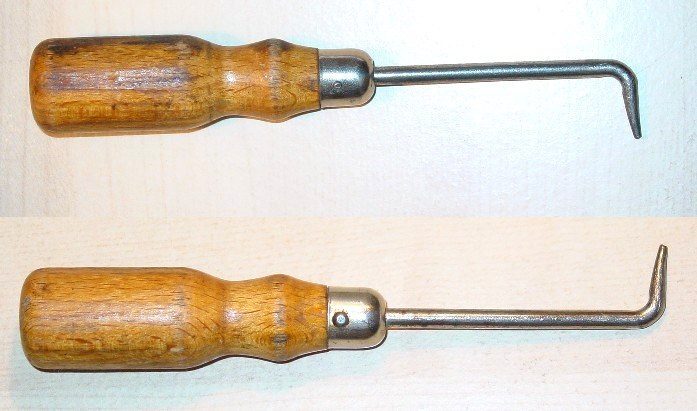 The 1963 hubcap puller. Originals are fluted like the screwdrivers; the Stoddard reproduction has two flats on the handle instead. Eric Cherneff
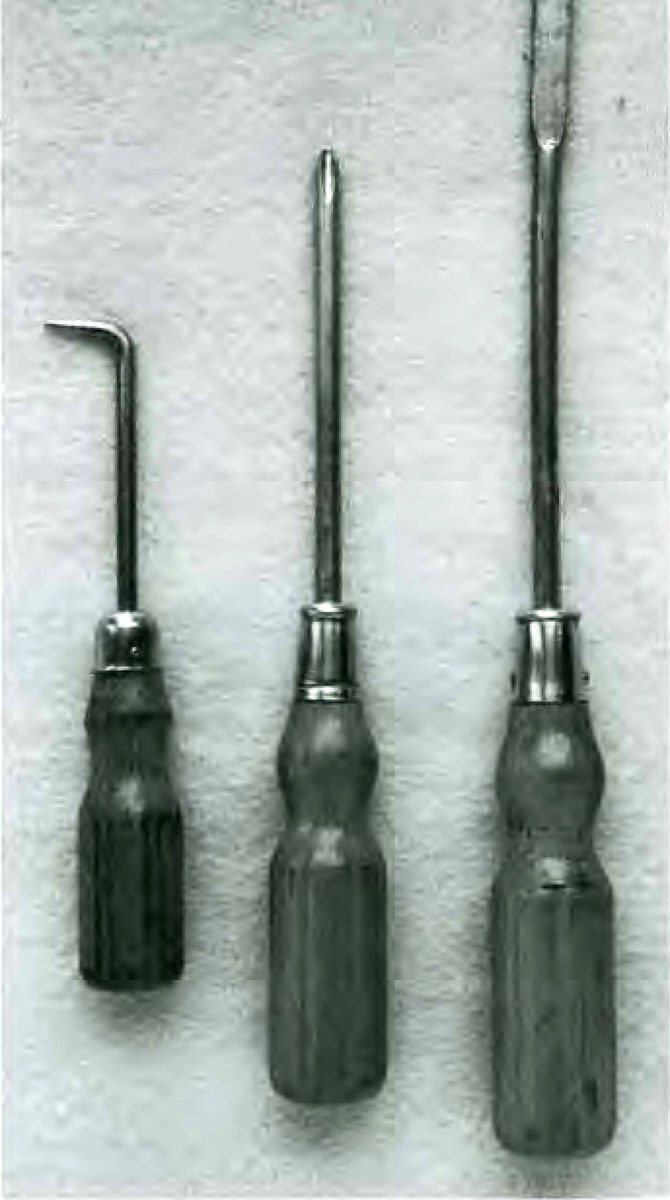 Left to right: the hubcap tool, the Phillips screwdriver and the flat head screwdriver of the tie-string kit. Jon Geil, 356 Registry magazine
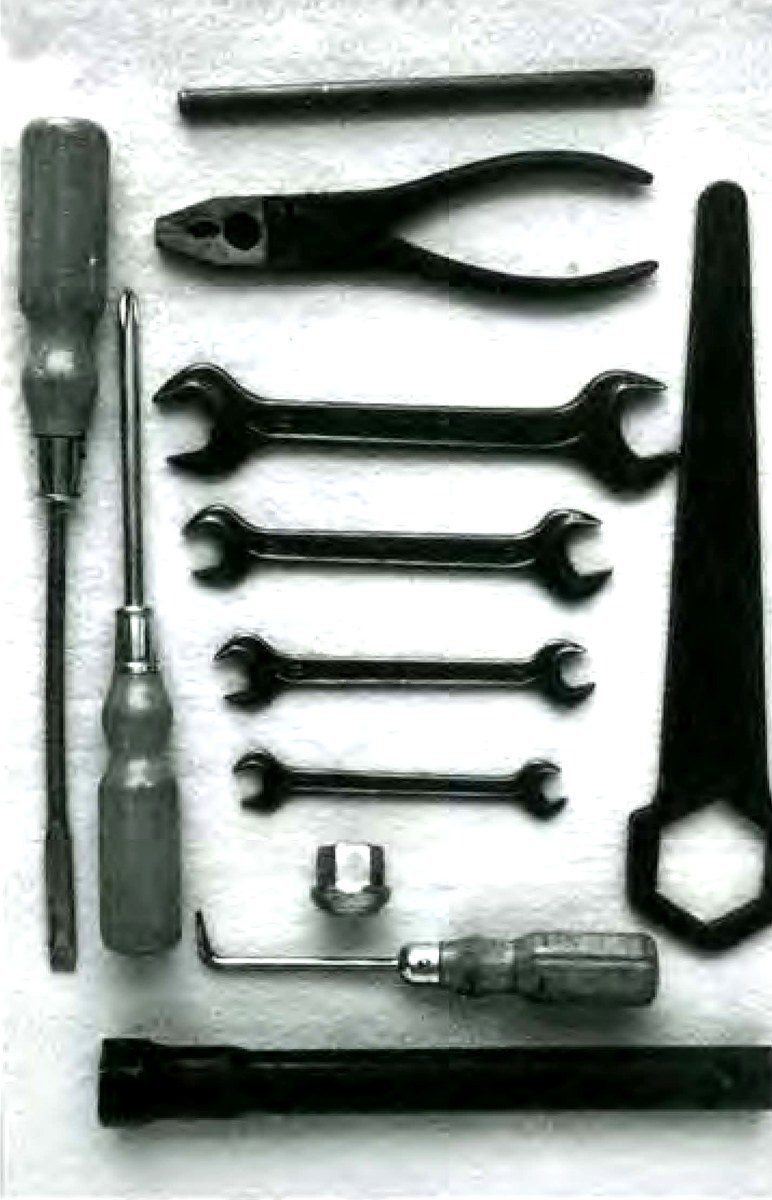 A complete set of tools for the tie-string kit. It carries neither a tire gauge nor a Hazet lug wrench. Jon Geil, 356 Registry magazine
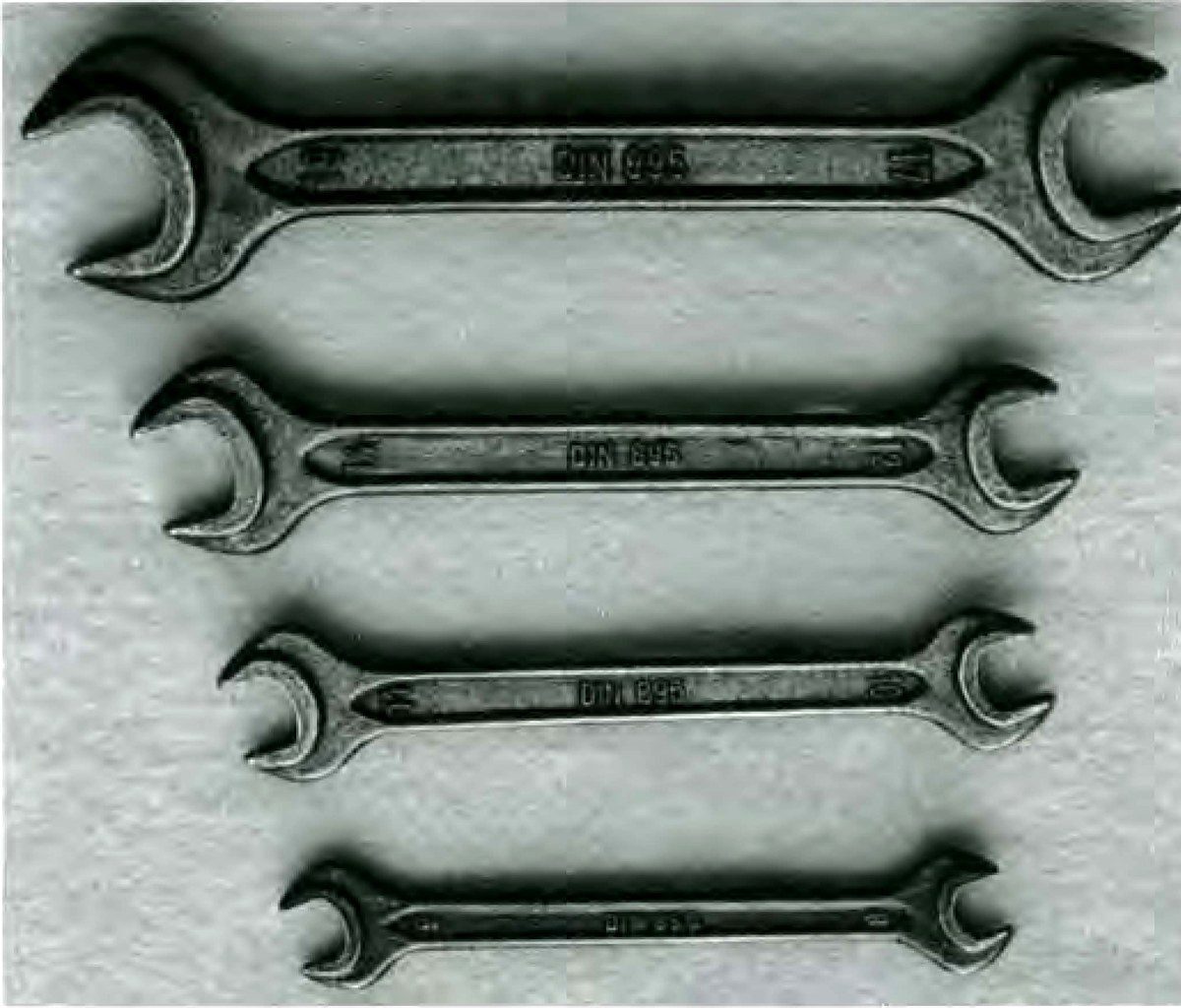 The four open-end wrenches of the tie-string kit, each marked DIN 895. Jon Geil, 356 Registry magazine
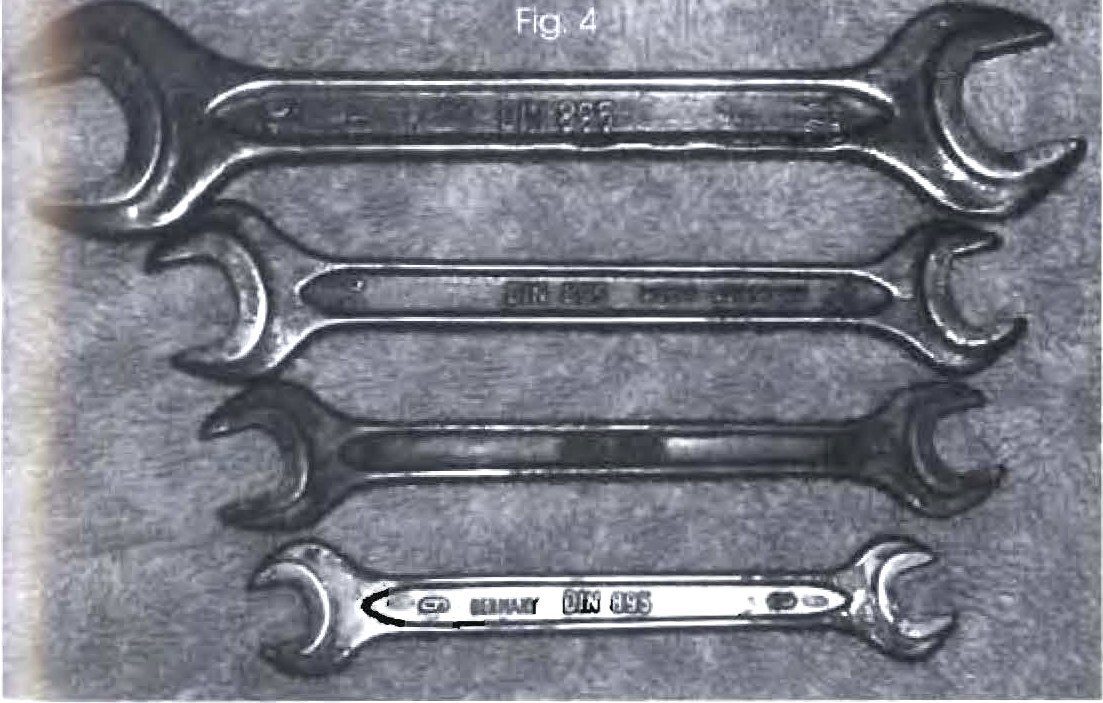 The DIN 895 no-name open-end wrenches of 1963. The size configuration differs from the Hazet set above it. A.C. Roda, 356 Registry magazine
Pliers
160mm, painted black, with flush cutting surfaces. The handles are shaped like parentheses rather than flowing in the S shape of the earlier pliers, which is the quickest way to tell them apart across a swap meet table. Some carry side cutting slots and some do not.Typical Citation 144The 1963 pliers are 160mm, painted black, flush cutting surfaces, with handles shaped like parentheses rather than the earlier S. Some have side cutting slots.Who says so Eric CherneffApplies to 1963Read the sourcesJim Perrin, “The 356 T6B “Tie-String” Tool Kit”, Vol. 25 No. 6Correct or add to this → · How these pages work
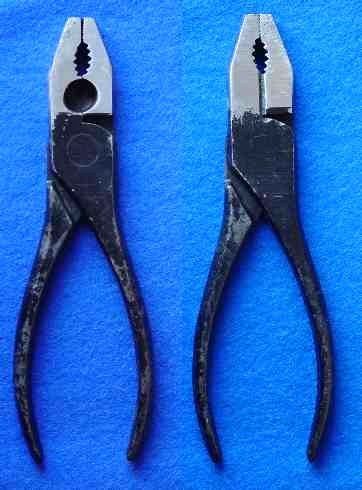 1963 pliers. The handles turn like parentheses rather than flowing in an S. Eric Cherneff
Fan belt
A Phoenix belt, marked Porsche, with a date stamp on the label. Belts of this period sit either side of a change nobody documented: “Made in Germany” was added to the label at no clean cut-off. The earliest belt seen carrying it is dated October 1962 and the latest without it is dated June 1963, so a 1963 car could correctly have either.Settled Citation 190'Made in Germany' was added to the Phoenix label at no clear cut-off: the earliest belt seen with it is dated October 1962, the latest without June 1963.Who says so Eric CherneffApplies to 1962-63Correct or add to this → · How these pages work
Belts of the same pattern were still being made long after 356 production ended, and a later Optibelt-branded belt carries the Porsche name and a Porsche part number,Typical Citation 191A later Optibelt brand belt is labeled Porsche with a Porsche part number.Who says so Eric CherneffApplies to laterCorrect or add to this → · How these pages work so a date code alone does not make a belt original equipment.
 A Phoenix belt dated June 1963, the latest seen without Made in Germany on the label. Eric Cherneff
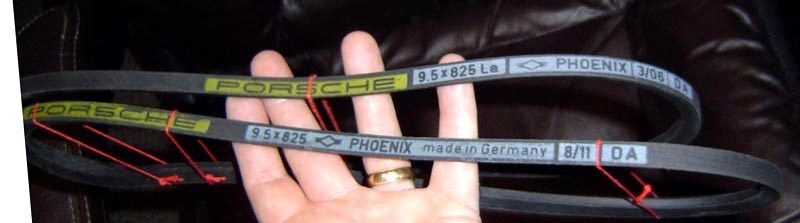 A November 1968 belt beside the June 1963 one. Belts of this pattern were still being made long after 356 production ended. Eric Cherneff
The 1978 owner’s manual survey puts this kit third of its four, dated to the January 1963 manual, and lists six changes in one go: an updated jack, a wood-handled hubcap puller added, the tire gauge deleted, the short screwdriver deleted leaving two, four wrenches of a different design from a different supplier, and a smaller bag.Settled Citation 465The January 1963 configuration updates the jack, adds a wood-handled hubcap puller, deletes the tire gauge, deletes the short screwdriver leaving two, takes four wrenches of a different design from a different supplier, and uses a smaller bag.Who says so magazineApplies to 1963Correct or add to this → · How these pages work
What we are still trying to settle
Is the late T6 bag vinyl the same material as the 1956 bags?The two-sided gray vinyl on these bags closely resembles what was used on the 1956 and earlier kits. If that is right it is a supply story, either the same material returning after six years or old stock being used up. It needs someone holding both.
Judgment Citation 57The two-sided vinyl on late T6 B bags closely resembles that used on 1956 and earlier bags.Who says so Eric CherneffApplies to late 1962-63Correct or add to this → · How these pages work When did the tie-string kit actually start?Perrin and Roda both put it in 1963, and Roda surveyed cars to say so. Two members describe a late 1962 start with an overlap, and one of them bought a car built 1 August 1962 from its original owner with red screwdrivers in a tie-string bag.
Open Citation 403Whether the tie-string kit began in mid 1962 or in 1963 is unresolved.Who says so No single source. Two sources disagree, as the statement above saysApplies to 1962-63Correct or add to this → · How these pages work Who made the DIN 895 wrenches?GEDORE and HEYCO have both been suggested and neither is confirmed. A marked example would settle it.
If you can answer any of these, or you think anything above is wrong, please write to Joe Owen.
From Pete Bartelli
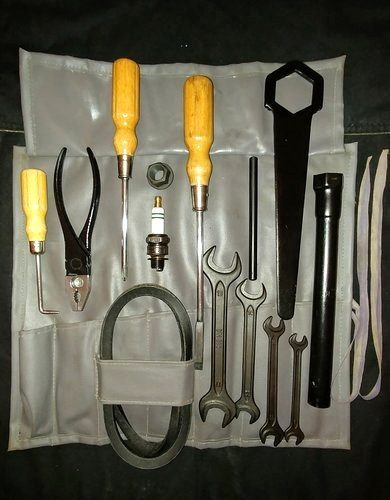 A 1963 pushrod B kit. Blonde handles, the black-oxide wrenches, and no tire gauge. Pete Bartelli
And the two spark plug sockets end to end, 1963 above and 1964 below.
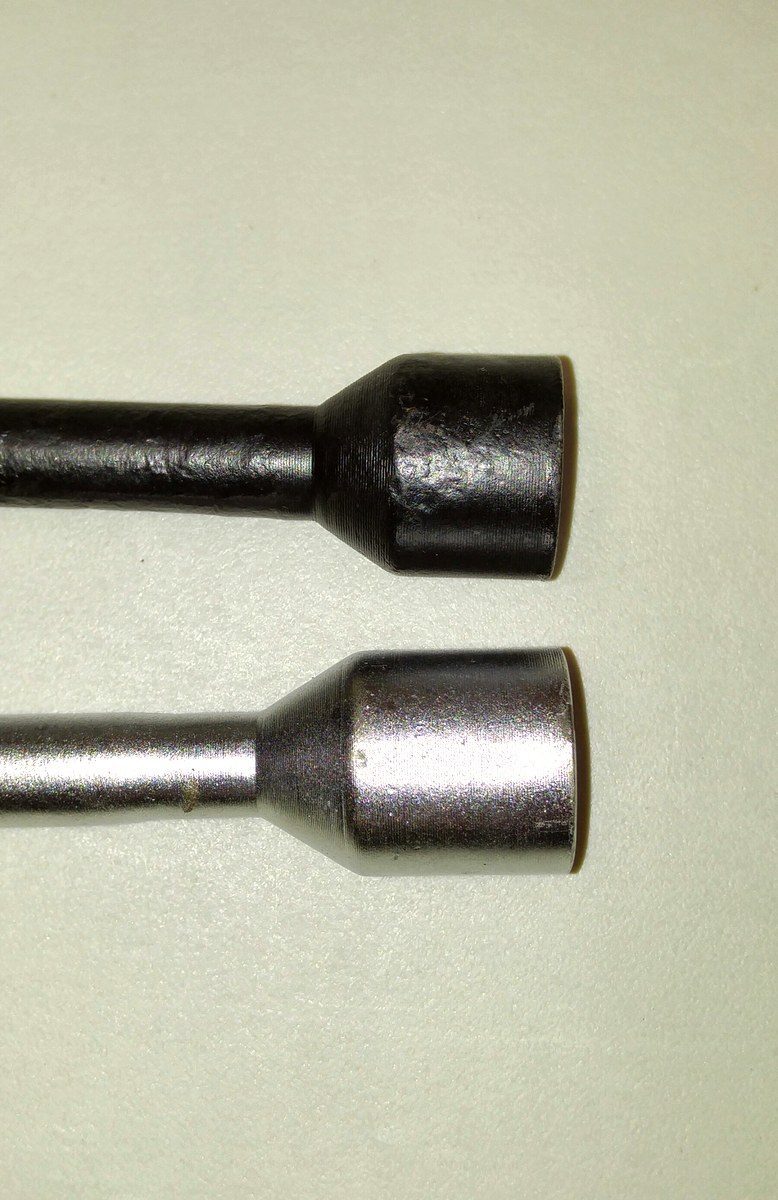 1963 above, 1964 below. The two spark plug sockets end to end. Pete Bartelli
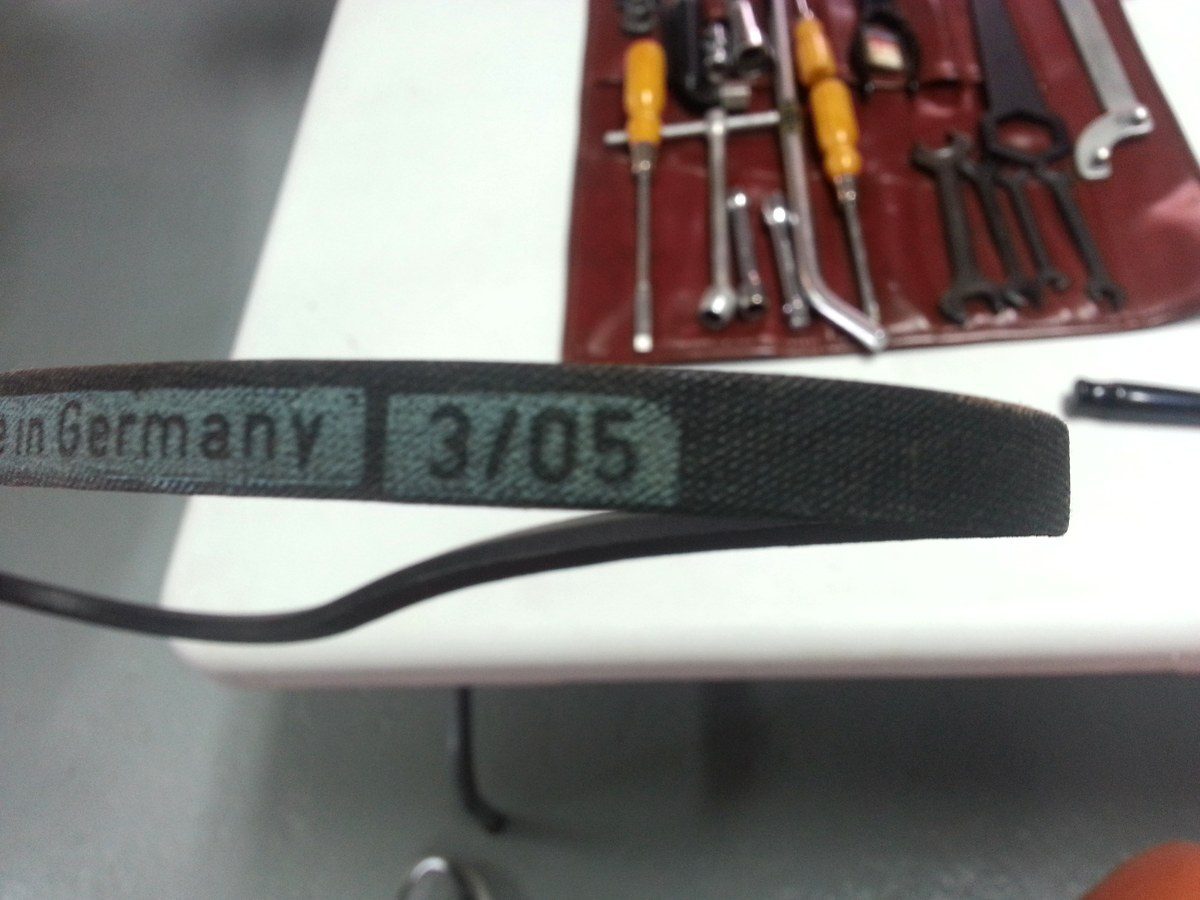 A belt Pete records as a Phoenix of May 1963, with its marking. Pete Bartelli
Where this comes from
Registry sources behind this page. You will need to be signed in to the Registry site to open them.
The 356 T6B “Tie-String” Tool KitV25610 · Jim Perrin · Vol. 25 No. 6356B Tool Kit ConfigurationsV18214 · A.C. Roda · Vol. 18 No. 2356 Tool Kit AccuracyV28112 · Eric Cherneff · Vol. 28 No. 1Restoration of 356 Tool Kit BagsV30620 · Eric Cherneff · Vol. 30 No. 6Restoration: tool kit research by Richard Miller and Charlie WhiteV12205 · Brett Johnson · Vol. 12 No. 2The Right Tools for No Job, Ever AgainV20109 · Gary Wolfgang · Vol. 20 No. 1Porsche 356A Tool KitsV24119 · Jim Perrin · Vol. 24 No. 1